
J. Dale Harvey
Lead Portfolio Manager
Dear Shareholder,
When I moved to California in 1991, I’d never heard of an El Niño. I soon learned that an El Niño forms when excessively warm water in the Pacific Ocean shifts the jet stream and the weather patterns it influences. As the graphic below shows (thank you, Gemini), this year’s El Niño is expected to dump more rain on the southern U.S., while northern Africa and Australia will get less. In drought-prone Southern California, the prospect of more rain might sound like welcome news, but what if this El Niño is, as the New York Times put it, a Super Godzilla Monster El Niño? Will we need sandbags to protect us from dangerous flooding and destructive hurricanes, or will cleaning out the gutters suffice?
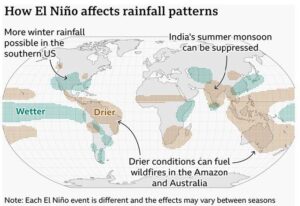
When I read the caption above — “Each El Niño event is different, and the effects may vary between seasons.” — I was reminded of the stock market. Like each El Niño, each Bull market is different, and the effects may vary between sectors. The current Bull market is technology driven. The heat from the billions of dollars being spent on artificial intelligence is spreading across the economy and benefiting those industries that are directly and indirectly involved in building data centers and filling them with racks upon racks of servers while interest-rate-sensitive sectors are struggling. On balance, the puts and takes between sectors have allowed profits to blossom to a degree few saw coming. Over time, stock prices tend to follow earnings and, if earnings continue to grow faster than expected, we believe this Bull market may continue to generate outstanding returns.
Don’t Rain Out My Golf Match!
According to FactSet, Wall Street sees 33% growth in earnings for the tech-heavy S&P 500 this year with another 15% in 2027 and 17% in 2028. Growth of this magnitude is unprecedented except for periods when depressed earnings due to recession are followed by explosive profit growth when the economy recovers. While I understand investor enthusiasm, I’m starting to worry about the sustainability of the earnings growth on which this bullishness is based.
As contrarians, we often worry when others grow excited and get enthusiastic when others start to panic. The stock market will probably keep marching higher if companies produce earnings at least in line with analysts’ expectations. The skies look clear right now, but the growing optimism about earnings growth is unlike anything I’ve seen in four decades of investing. As the chart below from Strategas Research illustrates, equity analysts are typically optimistic when predicting the future. As reality replaces optimism, earnings estimates tend to fall. That has not been the case so far this year – earnings estimates have climbed dramatically and pushed earnings far above long-term trends.
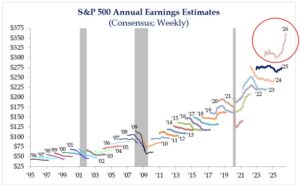
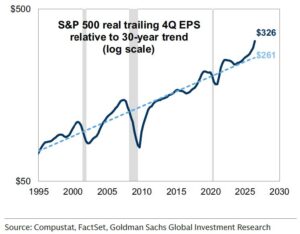
Over time, corporate earnings are cyclical. Earnings may grow at an above trend rate when the economy is strong, as it is today, and then give back those gains when the economy softens. Earnings are currently about 25% above trend. That doesn’t mean that earnings can’t keep growing, but it does highlight the downside risk to earnings if the economy were to weaken.
As we think about areas from which rain clouds could emerge, we are closely monitoring the speed of AI deployment, interest rates, the war in Iran, and consumer spending. Of these issues, I worry most about the Federal Reserve using interest rates to try to solve an inflation problem that monetary policy can’t fix. Put simply: increasing interest rates won’t open the Strait of Hormuz or reduce the Federal budget deficit.
Just as an El Niño may bring rain to California and drought to Australia, the AI buildout may be a bonanza for tech companies but a headwind for interest-rate-sensitive sectors like housing. Barring new regulations that force a slowing in spending, OpenAI and Anthropic seem likely to keep building data centers provided they continue to have access to the billions of dollars needed to construct them. A 1% or 2% increase in borrowing costs is unlikely to wash out what are viewed as critical, strategic investments. Ever-higher AI investments and continued deficit spending by the Federal Government may continue to put upward pressure on rates. In time, higher interest rates may depress stock valuations.
In contrast to data centers and Federal deficit spending, the housing market is very sensitive to rates. For example, an additional 1% in mortgage rates increases monthly payments by roughly 10%. Mortgage rates have already increased by roughly 0.5% in the last few months, and unaffordable homes are moving further out of reach. A directionally similar analysis applies to buying cars and other large ticket items purchased with installment loans.
The Federal Reserve is getting heat for not doing more to lessen inflation, but I don’t think their toolbox is suited to the challenge of inflation pressures driven by data center construction spending and high oil prices. Raising interest rates may further slow the housing and auto markets, but they won’t lower prices at the gas pump or grocery store. Furthermore, I found it ludicrous to hear Treasury Secretary Scott Bessent try to convince investors that long-term interest rates should fall and that he’d make that happen by issuing more short-term Treasury bills to fund the repurchase of long-term bonds. That’s a bit like me trying to negotiate with Mother Nature in hopes of stopping the rain forecast for the day of a golf outing. Mother Nature and the bond market have minds of their own.
Importantly, with Chairman Kevin Warsh in charge at the Fed, I think that we are back to an environment in which market conditions more directly influence interest rates. Market-based interest rates have risen this year due to the dynamics described above, and the recent increase in rates by the Fed is merely an acknowledgement that it agrees with the market’s assessment that inflation isn’t coming down as quickly as hoped. From a public policy perspective, I think this is a positive development. For years, savers were penalized by receiving paltry returns on their investments while borrowers were subsidized with historically low interest rates. The financial repression that flowed from the Fed’s response to the ’07-’08 Global Financial Crisis led to misallocations of capital, and I’m pleased that era is over.
With the Fed recently increasing short-term interest rates for the first time since 2023, the old Wall Street admonition “don’t fight the Fed” deserves attention. Historically, the pace of interest rate increases has mattered; if the Fed were to increase rates at two of their next three Fed meetings, stocks could be vulnerable to a tumble. However, if the rate path is more gradual and more of akin to fine tuning in response to continued economic strength, then stocks may continue to climb.
Buying Bathing Suits When the Weatherman Forecasts Rain
Affordability is getting a lot of attention these days, and it reminds me of the adage about the weather: everybody complains but no one does anything about it. Consumers have been forced to cut back on discretionary spending to pay for higher gas and grocery prices. Continued tensions in the Middle East and the resulting constrained oil exports are reverberating through the economy — both directly at the pump, and indirectly as high diesel fuel prices increase the cost of goods getting to stores.
As consumers have had to cut back on discretionary purchases, the revenues of many consumer companies have been growing more slowly, and it could get worse if the Iran war continues (or escalates). Fears of slowing spending are driving down the stock prices of many consumer companies. We are finding an increasing number of potentially attractive long-term investment opportunities that could recover strongly once the Iran war ends and oil prices fall. The Iranians seemed to believe that mid-term election pressure would cause the U.S. to back down, but that hasn’t proved to be the case, at least so far. At some point, someone’s got to blink.
The other factor pressuring sentiment regarding consumer spending is the idea that AI will destroy jobs. Maybe it will do so at some point, but predictions of an AI-driven jobs apocalypse have yet to materialize. In fact, job growth appears to be picking up, not shrinking, and the unemployment rate has trended down in recent months. Instead of AI killing off jobs, we believe that the nature of work is evolving with AI acting as a productivity enhancer. If that belief holds true, it could allow the economy to grow faster than it otherwise would have, given the slow growth in the labor force.
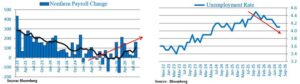
We have never claimed to have an edge in macroeconomic forecasting and that is why we build our portfolios from the bottom up, stock by stock. We primarily look for idiosyncratic opportunities where the blue-sky upside potential far outweighs the downside potential in a flash flood. During the third quarter, we added three new stocks to the portfolio, two of which are companies in the consumer sector.
Cognizant of the potential for heavy rain, however, we are focusing on what we believe to be financially strong businesses, and all three new investments were in companies with A-rated debt, as rated by Moody’s. These companies all generate prodigious amounts of free cash flow, and they have returned that cash to shareholders through dividends and share repurchases. They also have idiosyncratic characteristics that we believe may allow them to outrun the competition. Because of shifting sentiment, we were able to buy into these businesses at 14-15x earnings — a 20-30% discount to where they have historically been valued. We think that healthy free cash flow, strong balance sheets and discounted valuations provide an attractive margin of safety against a slowing economy.
Hoping for Sunshine, But Preparing for Rain
While we don’t know if the predicted weather patterns of the Super Godzilla Monster El Niño will pan out, we’ve been working to weatherproof our portfolio. Just as I recently hired a roofer to fix a few broken slate tiles on the top of our house, and made sure our gutters were cleaned out, the Poplar Forest Team at Tocqueville is managing our portfolios in a way that we believe can withstand even a deluge while being positioned for long-term gain when the sun shines. As you can see below, data from mutual fund rating service Morningstar illustrates that the companies we own offer above average growth and below average valuation compared to other Large Cap Value managers and to the Russell 1000 Value Index to which we are often compared. We think that above average growth at a below average valuation can be a rewarding formula for whatever weather comes our way.
| Poplar Forest Partners Fund (IPFPX) | Morningstar Large-Cap
Value Benchmark |
Russell 1000 Value Index | |
| Long-term Earnings Growth | 12.4% | 11.1% | 10.9% |
| Dividend Yield | 2.3% | 2.0% | 1.7% |
| Growth plus Yield | 14.7% | 13.1% | 12.6% |
| Price/Earnings Ratio | 13.8x | 16.9x | 18.4x |
| Source: Morningstar as of September 30, 2026 | |||
Finally, as I read headlines about a “Super Godzilla Monster El Niño,” the image that kept coming to mind is from the movie “Caddyshack.” Those of you of a certain age may remember the scene: Bishop Pickering is playing the game of his life despite being pelted by a seeming monsoon. After being advised to come in out of the rain, he asks his caddy Carl if he should continue playing. Carl (played by Bill Murray) responds, “I’d keep playing. I don’t think the heavy stuff is gonna come down for a while.” You may remember that things don’t work out well for the bishop.
I don’t know if the heavy stuff is going to come down soon, but we feel that the portfolio is prepared if it does. And if you haven’t already, go ahead and clean out your gutters while it’s still sunny out!
J. Dale Harvey
September 30, 2026
PS — if you don’t know the Caddyshack reference above, you can check it out here:
Click here for Standardized Performance and Top Ten Holdings: Partners Fund, Cornerstone Fund
Performance data quoted represents past performance; past performance does not guarantee future results. The investment return and principal value of an investment will fluctuate so that an investor’s shares, when redeemed, may be worth more or less than their original cost. Current performance of the fund may be lower or higher than the performance quoted. Performance data current to the most recent month end may be obtained by calling 877-522-8860.
Opinions expressed are subject to change at any time, are not guaranteed and should not be considered investment advice. Holdings and allocations are subject to change at any time and should not be considered a recommendation to buy or sell any security. Index performance is not indicative of a fund’s performance. Value stocks typically are less volatile than growth stocks; however, value stocks have a lower expected growth rate in earnings and sales.